
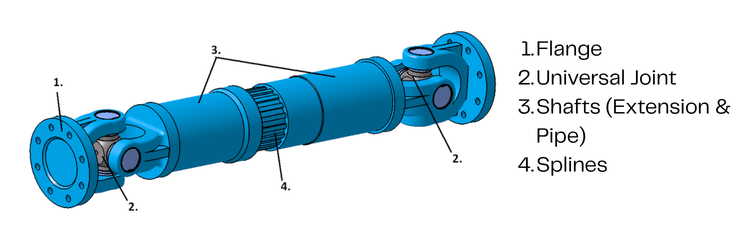
In many industrial plants, the first reaction to a driveline failure is to replace the cardan shaft and get the machine running again. In some cases, that works. But in many others, the same problem returns because the real cause was never identified.
A cardan shaft often fails because of something else in the system — misalignment, shock loading, incorrect shaft selection, vibration, or a problem in the connected equipment. In those situations, replacing the shaft alone only treats the symptom.
For maintenance teams, this creates a costly cycle of repeat failures, emergency repairs, and lost production. The better approach is to understand when replacement is enough and when the drivetrain needs a deeper engineering review.
Why Repeat Failures Usually Point to a Bigger Problem
If a shaft fails once after long service life, replacement may be the right answer. But if the same machine keeps damaging shafts again and again, the issue is probably not the shaft itself.
Common consequences of this cycle include:
- Repeated downtime
- Rising spare part costs
- Increased maintenance workload
- Damage to gearboxes, couplings, or bearings
- Higher safety risk during operation
When the same failure returns, it usually means the operating conditions are still unchanged. In other words, the new shaft is being placed into the same harmful environment as the old one.
When Cardan Shaft Replacement Alone Will Not Solve the Problem
1. The Shaft Fails Repeatedly in a Short Time
If the cardan shaft fails within months or weeks after replacement, that is a strong warning sign. The likely causes may include:
- Excessive misalignment
- Overloaded drivetrain
- Shock loading during operation
- Incorrect shaft geometry
- Poor installation conditions
In this case, replacing the shaft again without investigation will likely produce the same result.
2. Vibration Continues After Replacement
A new shaft should not keep vibrating if the drivetrain is healthy. If the vibration remains, the problem may lie in:
- Incorrect shaft length
- Wrong joint configuration
- Dynamic movement in the machine structure
- Structural deflection under load
- Imbalance in the connected drive system
Here, the shaft is not the root cause — it is only reacting to the condition around it.
3. Other Components Are Showing Damage Too
If the cardan shaft is failing along with gearbox bearings, motor bearings, couplings, or foundations, the drive system itself is under stress.
This may indicate:
- Poor alignment
- Resonance
- Excessive torque spikes
- Foundation movement
- Machine frame distortion
When multiple components are wearing out, replacing only the shaft will not solve the underlying issue.
4. The Application Has Heavy Shock Loads
Some industrial applications create sudden torque spikes that are much higher than normal operating loads. These are common in:
- Crushers
- Rolling mills
- Conveyors with heavy starts
- Mining equipment
- Start-stop drive systems
If the shaft is selected only for average load and not for peak load, it may fail early even if it appears strong enough on paper.
Why a “Stronger” Shaft Is Not Always the Answer
When shafts fail repeatedly, the instinct is often to choose a larger or heavier-duty replacement. But a stronger shaft does not automatically fix the problem.
In some cases, an oversized shaft can create new issues:
- Extra load on gearboxes or motors
- Higher bearing stress
- Installation difficulty
- Reduced flexibility in the driveline
- New vibration behavior
The drivetrain must be balanced as a system. More strength in one part can simply move the failure somewhere else.
What Should Be Checked Before Replacing the Shaft Again
Before ordering another cardan shaft, the application should be reviewed as a complete drive system.
A proper evaluation should include:
- Operating torque and peak torque
- Duty cycle and number of starts/stops
- Angular and parallel misalignment
- Shaft length and joint arrangement
- Thermal movement and structural deflection
- Installation method and maintenance history
- Condition of connected components
This helps determine whether the shaft is actually the problem or whether the issue is in the machine design or operating environment.
When Replacement Is the Right Solution
Replacement is still the correct answer in some cases.
It is usually suitable when:
- The original shaft was correctly selected
- The machine conditions have not changed
- The shaft failed due to normal wear at end of life
- Alignment and installation are within acceptable limits
- No other drivetrain damage is present
In those situations, replacement restores the system because the original design was sound.
The Value of Root-Cause Analysis
The most effective maintenance teams do not only ask, “Which shaft do we need?” They ask, “Why did this shaft fail?”
That is the purpose of root-cause analysis. It shifts the focus from part replacement to system reliability.
A root-cause review can reveal:
- Hidden misalignment
- Torque overload
- Vibration issues
- Unsupported shaft geometry
- Maintenance practices that shorten service life
Once the cause is known, the next replacement has a much better chance of lasting.
A Better Long-Term Approach
If a cardan shaft keeps failing, the best solution may involve more than a new shaft. It may require:
- Correcting alignment
- Adjusting shaft configuration
- Reviewing torque capacity
- Improving coupling or gearbox selection
- Modifying the driveline layout
- Addressing foundation or structure movement
This is why many repeat failures are solved by engineering changes, not just part swaps.
Final Thought
Cardan shafts do not fail in isolation. They fail as part of a mechanical system. That means the real solution is often not “replace faster,” but “understand better.”
When the root cause is addressed, the drivetrain becomes more reliable, maintenance costs drop, and downtime is reduced.
Need Help Reviewing a Repeated Cardan Shaft Failure?
If your equipment is experiencing repeated cardan shaft failures, vibration, or unexplained drivetrain damage, a proper application review can help identify the real cause.
METAL Mobility Drive Systems supports industrial operators, maintenance teams, and engineering companies with driveline review and sourcing support across the Middle East, Africa, and South Asia.
Email: sales@statusmobility.com
Phone / WhatsApp: +971-585730206
Tags: Cardan Shaft, Industrial Drive Shafts, Universal Joint Shafts, Cardan Shaft Maintenance, Cardan Shaft Replacement, Industrial Power Transmission, Heavy Machinery Drivetrain