
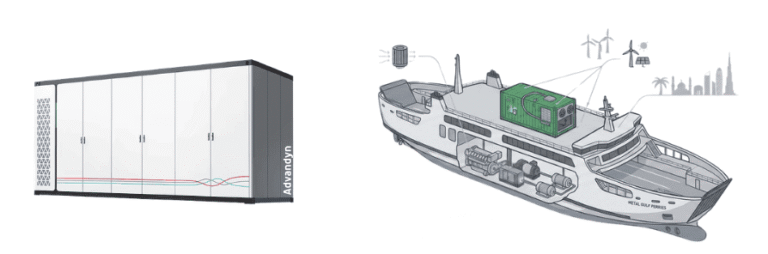
The maritime industry in the Middle East is currently standing at its most significant crossroads since the transition from sail to steam. As the global push for maritime decarbonization accelerates under the International Maritime Organization’s (IMO) revised Greenhouse Gas (GHG) strategy, the Arabian Gulf is emerging as a primary laboratory for large-scale hybrid and electric propulsion adoption.
From the massive port expansions in the Kingdom of Saudi Arabia to the established maritime hubs in Dubai and the specialized offshore fleets in Abu Dhabi and Qatar, the integration of Marine Battery Energy Storage Systems (BESS) is no longer an experimental luxury—it is a strategic necessity.
The Regional Imperative: Why the GCC is Pivoting to BESS
The Middle East is uniquely positioned to lead the marine energy transition. The region’s strategic vision—epitomized by the UAE’s Net Zero by 2050 Strategic Initiative, Saudi Arabia’s Vision 2030, and the Qatar National Vision 2030—has created a regulatory environment that prioritizes sustainability and energy efficiency.
However, the shift to hybrid marine power in the Middle East isn’t just about environmental compliance; it is about operational survival. The region’s specific maritime challenges, including extreme ambient temperatures, high humidity, and the demanding duty cycles of offshore support vessels (OSVs) and port tugs, require a sophisticated approach to power management.
The Technical Synergy: Drivetrain Engineering Meets Energy Storage
At METAL Mobility, our legacy is built on the mechanical backbone of the maritime industry. We understand that a vessel’s performance is determined by the seamless interaction between the power source and the propulsion line. When we discuss BESS in 2026, we aren’t just talking about “batteries”; we are talking about a complete reimagining of the marine drivetrain.
The Mechanical Advantage of Hybridization
Traditional marine engines are designed to operate most efficiently at a specific load point (usually 70-85%). In the Gulf, many vessels—particularly those in the oil and gas sector in Saudi Arabia and Kuwait—spend significant time idling or in dynamic positioning (DP) mode. This leads to:
- Engine Glazing: Due to low-load operation.
- Excessive Vibration: Straining Cardan shafts and SAE couplings.
- Increased Maintenance: Frequent overhauls of gearboxes and drivetrain components.
Integrating a BESS allows for “Peak Shaving” and “Strategic Loading.” The batteries handle the sudden load spikes and low-load maneuvers, allowing the main engines to remain off or run at their most efficient “sweet spot.” This mechanical synergy significantly extends the life of the mechanical components, reducing the Total Cost of Ownership (TCO).
Overcoming Environmental Barriers: Heat, Humidity, and Salinity
Designing a BESS for the North Sea is one thing; designing one for the Port of Jebel Ali or the Red Sea is quite another. Ambient temperatures in the Middle East can exceed 50°C, presenting a major challenge for battery chemistry and thermal management.
A high-authority Marine BESS must account for:
- Active Liquid Cooling: Air-cooled systems are often insufficient for the high-density energy requirements of Middle Eastern vessels.
- IP-Rated Enclosures: Protecting sensitive lithium-ion cells from the corrosive, salt-laden air of the Gulf.
- Advanced Battery Management Systems (BMS): Sophisticated AI-driven software that monitors cell health in real-time, preventing thermal runaway in extreme climates.
To address these specialized needs, our dedicated division, Advandyn, has expertise BESS architectures specifically engineered for the “Hot-Climate Marine Profile.” While METAL Mobility Drive Systems support mechanical integration is flawless, Advandyn provides the high-performance energy storage units capable of thriving in the regional environment.
Market Analysis: BESS Adoption Across the GCC
United Arab Emirates: The Innovation Hub
The UAE, particularly through entities like ADNOC and the DP World network, is leading the charge in port electrification. Dubai is becoming a global reference point for electric abra ferries and hybrid/ electric vessels. For UAE operators, BESS integration is often driven by “Operational Silence” requirements and ESG mandates.
Kingdom of Saudi Arabia: Scaling for Vision 2030
With the development of NEOM and the Red Sea Global projects, KSA is building the world’s most sustainable maritime infrastructure from the ground up. The demand for zero-emission passenger ferries and research vessels in the Red Sea is creating a massive market for modular BESS solutions.
Qatar: The LNG and Offshore Powerhouse
Qatar’s massive offshore fleet, supporting the North Field expansion, stands to gain the most from hybrid retrofits. By adding BESS to existing OSVs, operators can reduce “Spinning Reserve” requirements, saving thousands of liters of fuel per day during DP operations.
Oman, Bahrain, and Kuwait: Specialized Applications
Oman is focusing on sustainable fisheries and coastal tourism, while Bahrain and Kuwait are looking at BESS for modernization of their utility and security fleets. The common thread is the need for ruggedized, local support—something the METAL Mobility Group provides through our offices in Dubai, Ajman, and Umm Al Quwain.
The Economic Reality: ROI of Marine BESS
The primary question for any shipowner in the Middle East is: What is the payback period? In 2026, the ROI of a Marine BESS is driven by three factors:
- Fuel Displacement: With global fuel prices remaining volatile, a 15-25% reduction in fuel consumption provides a clear path to payback, often within 3 to 6 years.
- Maintenance Savings: By reducing engine hours by up to 40% in some duty cycles, the interval between major engine and drivetrain overhauls is nearly doubled.
- Regulatory Compliance: As “Green Ports” in the UAE and KSA begin to implement carbon taxes or preferential berthing fees for hybrid vessels, the cost of not having a BESS begins to outweigh the investment.
Why Choose the METAL Mobility & Advandyn Ecosystem?
Successfully transitioning to a hybrid or electric fleet requires a multi-disciplinary partner. You need an entity that understands the torque requirements of a marine gearbox as well as the C-rate of a lithium-iron-phosphate (LFP) battery.
At METAL Mobility, we provide the heavy engineering expertise. Our teams specialize in the mechanical drive systems, designing of custom battery systems, and the installation of drivetrain components that can handle the unique power curves of electric motors.
However, the “heart” of the system—the energy storage itself—is where Advandyn excels. Advandyn’s Marine BESS solutions are:
- Chemistry Agnostic: Utilizing the safest and most energy-dense cells for the specific application.
- Modular by Design: Allowing for easy upgrades as battery technology evolves.
- Locally Supported: Our UAE-based engineers provide rapid response times, ensuring your vessel stays in the water, not in the drydock.
Conclusion: Bridging Tradition and Transformation
The future of Middle Eastern maritime power is not a choice between “Mechanical” or “Electrical.” It is a sophisticated blend of both. By pairing the mechanical reliability of METAL Mobility with the latest energy storage technology of Advandyn, regional operators can achieve a level of efficiency and sustainability that was previously thought impossible in our extreme climate.
As we look toward the remainder of 2026 and beyond, the vessels that dominate the Gulf will be those that embrace this hybrid reality today.
Ready to Modernize Your Fleet?
Whether you are looking for a complete hybrid retrofit for an offshore fleet in Abu Dhabi or seeking specialized drivetrain components for a new build in Dammam, our group is ready to assist.
- Explore Mechanical Solutions: Visit METAL Mobility for driveline solutions.
- Explore Energy Storage: Visit Advandyn for a technical consultation on Marine BESS and hybrid power integration.
 Email: sales@statusmobility.com