
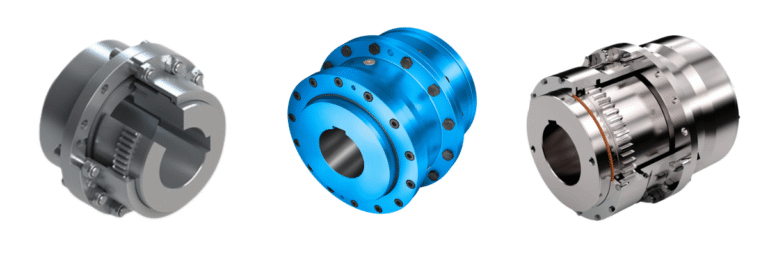
Industrial gear couplings remain one of the most reliable solutions for transmitting high torque between rotating shafts in demanding industrial applications. From steel mills and cement plants to mining operations, marine propulsion systems, pumps, compressors, and power generation equipment, gear couplings are trusted for their strength, durability, and ability to operate under severe service conditions.
As industries across the Middle East and Africa continue to modernize their rotating equipment, many maintenance teams face a common challenge—finding reliable replacement gear couplings or interchangeable solutions for ageing installations from manufacturers such as FLENDER, KTR, Falk, Bibby, and other well-known brands.
This guide explains how industrial gear couplings work, where they are used, how to select the right model, and what to consider when replacing an existing gear coupling.
What is an Industrial Gear Coupling?
An industrial gear coupling is a flexible mechanical coupling designed to transmit high torque between two rotating shafts while accommodating limited angular, axial, and radial misalignment.
Unlike rigid couplings, gear couplings use precision-machined external and internal gear teeth that allow the coupling hubs to articulate during operation while maintaining efficient torque transmission.
Their compact design, high torque density, and excellent durability make them one of the preferred coupling solutions for heavy industrial machinery.
How Does a Gear Coupling Work?
A gear coupling consists primarily of:
- Two externally geared hubs
- Two internally geared sleeves
- Seals
- Lubrication system
- Fasteners
The crowned gear teeth permit slight shaft misalignment while maintaining full torque transmission.
Proper lubrication minimizes wear between the gear teeth, allowing the coupling to operate reliably under heavy loads for many years.
Advantages of Industrial Gear Couplings
Industrial gear couplings continue to be widely specified because they offer:
- Very high torque transmission capacity
- Compact dimensions compared to torque rating
- Excellent overload capability
- Accommodation of angular, axial and radial misalignment
- Long service life
- Suitable for high-speed applications
- Reliable performance under shock loads
- Proven technology for demanding industrial environments
These characteristics make gear couplings suitable for both new equipment and retrofit projects.
Common Industrial Applications for Gear Couplings
Gear couplings are used in almost every heavy industry where reliable torque transmission is essential.
Typical applications include:
Steel Industry
- Rolling mills
- Continuous casting machines
- Slab conveyors
- Billet handling equipment
Cement Industry
- Kiln drives
- Ball mills
- Vertical roller mills
- Bucket elevators
- Crushers
Mining & Mineral Processing
- Conveyors
- Crushers
- Grinding mills
- Stackers and reclaimers
Oil & Gas
- Pumps
- Compressors
- Cooling systems
- Gas processing equipment
Power Generation
- Boiler feed pumps
- Cooling water pumps
- Generator auxiliary drives
- Air compressors
Marine & Ports
- Propulsion systems
- Winches
- Deck machinery
- Cranes
Water & Wastewater
- High-capacity pumps
- Aeration blowers
- Mixing equipment
When Should a Gear Coupling Be Replaced?
Many gear couplings remain in service for decades, but eventually wear becomes unavoidable.
Common replacement indicators include:
- Excessive backlash
- Worn gear teeth
- Oil leakage
- Cracked sleeves
- Hub damage
- Excessive vibration
- Lubrication contamination
- Repeated seal failures
Replacing worn gear couplings before catastrophic failure helps prevent damage to bearings, shafts, gearboxes, motors, and driven equipment.
Replacing Existing Gear Couplings
Many industrial facilities operate legacy equipment originally supplied with gear couplings from manufacturers such as:
- FLENDER
- KTR
- Falk
- Bibby
- Renold
- Lovejoy
- Rexnord
- Ameridrives
When OEM spare parts become expensive, obsolete, or have long delivery times, a technically equivalent replacement gear coupling can often restore equipment performance while reducing downtime.
Successful replacement requires evaluation of:
- Torque capacity
- Operating speed
- Shaft diameter
- Hub connection
- Service factor
- Misalignment limits
- Overall dimensions
- Distance Between Shaft Ends (DBSE)
- Existing installation constraints
Selecting a replacement based solely on dimensions is rarely sufficient. Proper engineering evaluation ensures compatibility and long-term reliability.
Key Selection Criteria for Industrial Gear Couplings
Every application should be evaluated based on its operating conditions.
Important selection factors include:
Transmitted Torque
The coupling must safely transmit both continuous and peak torque.
Service Factor
Shock loads, reversing duty, and frequent starts must be considered.
Shaft Sizes
Hub bore dimensions and shaft connections must match the existing equipment.
Speed
Operating speed affects balancing requirements and lubrication.
Misalignment
Angular, radial, and axial misalignment should remain within allowable limits.
Environment
Applications exposed to dust, moisture, high temperatures, corrosive chemicals, or marine environments may require special materials or sealing arrangements.
Gear Coupling Solutions for Middle East Industries
Industrial facilities throughout the UAE, Saudi Arabia, Qatar, Oman, Kuwait, Bahrain, Iraq, Egypt, and Africa often operate in demanding environments characterized by:
- High ambient temperatures
- Continuous operation
- Heavy process loads
- Dust and abrasive conditions
- Limited shutdown windows
Selecting the correct industrial gear coupling becomes critical to reducing maintenance costs and maximizing equipment availability.
Whether for new projects or replacement requirements, engineering support helps ensure the selected coupling matches the application’s mechanical and operational demands.
Industries We Support
METAL Mobility supports customers across the Middle East and Africa with gear coupling solutions for:
- Cement plants
- Steel mills
- Mining operations
- Power generation
- Oil & gas
- Petrochemical facilities
- Water treatment plants
- Marine and offshore
- Ports
- Bulk material handling
- Paper mills
- Sugar plants
- Industrial OEMs
- EPC contractors
- Maintenance companies
Why Choose METAL Mobility?
METAL Mobility provides application-based support for industrial power transmission systems throughout the Middle East and Africa.
Our capabilities include:
- Industrial gear coupling selection
- Replacement solutions for existing installations
- Technical evaluation of operating conditions
- Assistance with obsolete coupling replacement
- Support for OEM and aftermarket requirements
- Fast regional response
- Engineering-driven recommendations
Our objective is not simply to supply a coupling, but to provide the most suitable solution for your application.
Need Help Selecting or Replacing an Industrial Gear Coupling?
Whether you’re specifying a coupling for a new installation or replacing an existing FLENDER, KTR, Falk, Bibby, Rexnord, Renold, or other industrial gear coupling, METAL Mobility can help you identify a technically suitable solution.
Our engineering team supports customers across the UAE, Saudi Arabia, Oman, Qatar, Kuwait, Bahrain, and the wider Middle East and Africa with application-based gear coupling selection and replacement support.
Contact us today:
 sales@statusmobility.com