
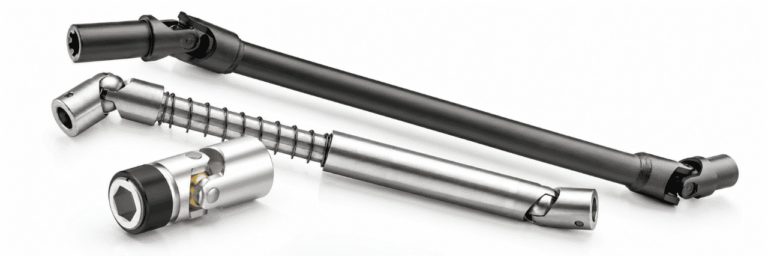
In modern industrial machinery, reliable power transmission depends on selecting the right drive components for the application’s operating conditions. Where two shafts cannot be positioned on a common axis, or where space constraints, angular movement and specific torque requirements influence the drivetrain design, a suitable articulated shaft can provide an effective mechanical connection.
Precision Cardan shafts, universal joint shafts and ball and socket shafts serve different purposes within mechanical power transmission. Choosing between them requires consideration of operating speed, transmitted torque, angular deflection, installation length, bearing design and maintenance requirements.
Elbe Elso, part of the Elbe Group, offers specialised drive shaft solutions for mechanical engineering, industrial machinery, service and maintenance applications. Through METAL Mobility Group, customers in the UAE and wider Middle East can discuss application requirements for suitable ELSO drive shaft solutions.
What Is a Precision Cardan Shaft?
A precision Cardan shaft is a mechanical drive component designed to transmit rotary motion and torque between connected components positioned at an angle to one another.
Precision Cardan shafts are particularly relevant to applications requiring compact construction, accurate motion transmission and defined operating characteristics. Depending on the design, they can accommodate angular deflection while connecting the driving and driven elements of a machine.
Elbe’s Series 0.600 precision Cardan shafts are based on DIN 808 and offer a range of configurations for different installation and operating requirements.
Published specifications include:
- Maximum torque range: 6–250 Nm across the series
- Rotational speed: up to 5,000 rpm
- Maximum angular deflection: up to 45°
- Hub bore diameters: 10–40 mm
- Lengths: 40–4,000 mm
- Single and double configurations
- Versions with or without length extension
- Needle-bearing versions described as maintenance-free, with optional plain-bearing cross-joint configurations
These are series-level limits, not simultaneous ratings for every size. The permissible torque depends on operating speed, articulation angle and other application conditions. The correct configuration must be verified against the manufacturer’s technical guidelines.
Where Are Precision Cardan Shafts Used?
Precision drive shafts are useful where a machine’s mechanical arrangement requires rotary motion to be transmitted between components that are not perfectly aligned.
Potential applications include the following.
1. Special-purpose machinery and automation equipment
Special-purpose machines often incorporate adjustment mechanisms, compact drive arrangements and components installed at different angles.
A precision universal joint shaft can connect these components while accommodating the specified angular displacement. Depending on the duty, it may be used in positioning mechanisms, machine adjustments, compact transmission assemblies and other rotary drive arrangements.
Selection should account for the required speed, torque, operating cycle and movement accuracy.
2. Test benches and measuring equipment
Test benches and specialised equipment may require a compact mechanical connection between a drive and a test assembly.
A precision Cardan shaft can be considered where the installation requires defined angular flexibility and controlled rotary transmission. The shaft must still be selected according to the test rig’s speed, torque, alignment and measurement requirements.
Where measurement accuracy is critical, the complete drivetrain’s mechanical behaviour must be evaluated rather than assuming that a precision shaft alone guarantees system accuracy.
3. Packaging and production machinery
Packaging equipment and production lines may contain adjustment mechanisms, rotating assemblies and drive components within restricted installation spaces.
Depending on the machine design, a precision Cardan shaft or universal joint shaft can help transmit motion between components that cannot be connected directly on a common axis.
The choice between the two depends on operating speed, torque, duty cycle, joint design and whether continuous operation is required.
4. Industrial equipment and maintenance applications
During machine refurbishment or maintenance, an existing drive shaft may require replacement because of wear, dimensional changes or an updated machine arrangement.
Identifying the correct replacement requires more than measuring the shaft’s overall length. Engineers should confirm the connection geometry, bore and keyway dimensions, required articulation angle, torque, speed and installation arrangement.
Elbe Elso offers different drive shaft configurations and material options, allowing suitable variants to be assessed against the actual application requirements.
Precision Cardan Shafts vs. Universal Joint Shafts vs. Ball and Socket Shafts
Although these terms are sometimes used interchangeably, the three product families have different design characteristics and operating envelopes.
Precision Cardan shafts — for higher-speed precision drives
Elbe’s Series 0.600 precision Cardan shafts are designed for precise power transmission at relatively high rotational speeds. The range supports different connection types, lengths and configurations, making it relevant to selected applications in mechanical engineering and industrial machinery.
They are worth considering when a compact drive connection requires defined angular flexibility and higher operating speed capability.
Universal joint shafts — for practical angular power transmission
Elbe’s Series 0.700 universal joint shafts are designed for torque transmission where the connected components operate at an angle to one another.
Published series specifications include:
- Maximum torque range: 6–450 Nm
- Rotational speed: up to 1,000 rpm
- Maximum angular deflection: up to 45°
- Hub bore diameters: 10–40 mm
- Lengths: 34–4,000 mm
- Single and double versions, with optional length extension
These shafts may be suitable for selected mechanical and plant engineering applications, adjustment mechanisms and other rotary drive systems.
A key engineering consideration is that a single conventional universal joint operating at an angle produces cyclic output-speed variation. Where uniform rotational motion is required, the complete joint arrangement must be designed accordingly. A double-joint arrangement does not automatically eliminate these variations unless the relevant geometry and operating conditions are satisfied.
Universal joint shafts in this product family should not be confused with every type of heavy-duty industrial Cardan shaft or automotive propeller shaft.
Ball and socket shafts — for compact, higher-torque, lower-speed drives
Elbe’s Series 0.800 ball and socket shafts use a different joint design and are intended for applications requiring relatively high torque in a compact installation space at lower rotational speeds.
Published series specifications include:
- Maximum torque range: 20–1,250 Nm
- Rotational speed: up to 500 rpm
- Maximum angular deflection: up to 35°
- Hub bore diameters: 10–70 mm
- Lengths: 50–4,000 mm
- Single and double configurations, with or without length extension
Potential applications include selected machine adjustment mechanisms, compact manual drives and other low-speed mechanical systems.
The design’s suitability depends on torque, speed, angular deflection, duty cycle and lubrication requirements. Elbe specifies lubrication for this product family, which must be considered when assessing maintenance intervals and accessibility.
How to Select the Right Elbe Elso Drive Shaft
The most appropriate drive shaft is the one that meets the complete set of application requirements—not simply the one with a matching bore or nominal torque rating.
Before selecting a precision Cardan shaft, universal joint shaft or ball and socket shaft, consider the following factors.
1. Operating torque
Determine the required transmitted torque and the nature of the load. Starting loads, intermittent operation, shock loads and frequent reversals can affect the selection.
Confirm the permissible torque at the actual operating speed and articulation angle rather than relying solely on the maximum series rating.
2. Rotational speed
Speed is particularly important when selecting precision drive shafts. A shaft that meets the torque requirement at a low speed may not be suitable for the same torque at a much higher speed.
Always confirm the manufacturer’s permitted operating conditions for the selected size and configuration.
3. Angular deflection
Measure the angle between the driving and driven shafts and establish whether it remains constant or changes during operation.
The permissible angle varies by product family and configuration. Where double joints are used, the joint arrangement and geometry must also be considered.
4. Installation length and movement
Determine the required shaft length, available installation space and whether axial length compensation is necessary.
Elbe’s precision Cardan shaft range and other shaft families offer different configurations, including versions with length extension. The suitability of each design depends on the application’s movement and connection requirements.
5. Connection geometry
Confirm all relevant interface details, including:
- Shaft and hub bore diameters
- Keyway dimensions
- Square or hexagonal connections, where applicable
- Required quick-release connections
- Available installation space
- Required shaft length and extension
Correct interface data helps avoid fitment problems and unnecessary modifications during installation.
6. Materials and operating environment
The required material and surface finish depend on the environment and application. Elbe lists options including standard steel, stainless steel, high-strength steel, aluminium and material combinations across the relevant product ranges.
Environmental exposure, corrosion risk, temperature and maintenance accessibility should be considered before finalising the configuration.
7. Maintenance and service life
Check whether the selected version requires lubrication, whether maintenance access is available and whether the operating cycle is compatible with the design.
Maintenance-free configurations are available in certain product families, but the designation and conditions should be confirmed for the selected version.
Why Application-Based Shaft Selection Matters
Selecting a shaft solely by diameter or nominal torque can result in an unsuitable drive arrangement.
For example, a high-speed precision mechanism may require a different shaft design from a compact adjustment drive that transmits higher torque at a low rotational speed. Similarly, an installation that requires axial length compensation may need a different configuration from a fixed-length connection.
Application-based selection helps engineering and maintenance teams evaluate the relevant variables together, including speed, torque, angular deflection, connection geometry, operating cycle and maintenance requirements.
For OEMs and machine builders, this information is particularly valuable during new equipment development, prototype construction, design modifications and repeat production.
For maintenance teams, accurate technical information can help identify a suitable replacement and reduce the risk of repeated fitment or operating problems.
Elbe Elso Precision Drive Shafts for UAE and Middle East Applications
Industrial equipment manufacturers, machine builders and maintenance teams across the UAE and Middle East work with a wide range of drive arrangements and installation constraints.
METAL Mobility Drive Systems, represents Elbe Group products in the GCC and supports customers seeking suitable drive shaft solutions for industrial and mechanical engineering applications.
Our focus is to help customers identify the appropriate product family and configuration based on their technical requirements, whether they need a precision Cardan shaft, a universal joint shaft or a ball and socket shaft.
We encourage OEMs, engineering contractors, maintenance teams and industrial end users to share their application data so that the appropriate product can be evaluated against the manufacturer’s specifications.
Request a Precision Cardan Shaft or Universal Joint Shaft
Looking for Elbe Elso precision Cardan shafts, DIN 808 universal joint shafts or ball and socket shafts for an industrial machine or OEM application?
To help us assess your requirements, please provide:
- Application or machine description
- Required torque and rotational speed
- Shaft angle or angular deflection
- Required shaft length and any axial movement
- Shaft or hub bore and connection dimensions
- Existing part number, if available
- Photographs, sketches or technical drawings
- Operating cycle and environmental conditions
Contact METAL Mobility Group to discuss your application and identify a suitable Elbe Elso drive shaft solution for your requirements.
Email: sales@statusmobility.com