
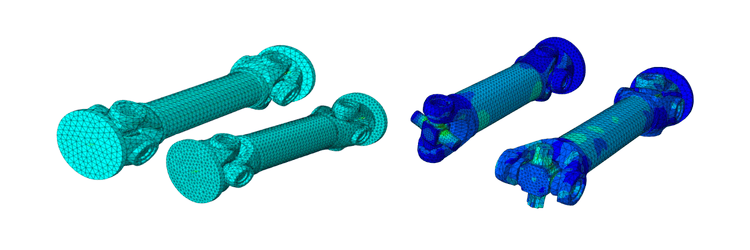
In heavy industry, a failed cardan shaft is often blamed on the shaft itself. In many cases, that is not the real problem.
Premature cardan shaft failure usually points to a system issue: incorrect sizing, excessive misalignment, shock loading, poor installation, or unsuitable operating conditions. In steel plants, cement plants, mining operations, power generation facilities, and bulk handling systems, these issues can quickly lead to repeat failures if the root cause is not identified.
Replacing the shaft without fixing the underlying problem often leads to the same result again: downtime, higher maintenance cost, and damage to connected equipment.
This article explains why cardan shafts fail early in heavy-duty applications and what maintenance teams should check before ordering another replacement.
The Real Impact of a Cardan Shaft Failure
A cardan shaft failure is rarely a small problem. In a heavy industrial drivetrain, one failed component can affect the entire machine.
The consequences may include:
- Production stoppage
- Damage to gearboxes, bearings, or couplings
- Emergency repair costs
- Unplanned logistics and replacement delays
- Safety risks during sudden failure
- Repeated downtime if the root cause is ignored
For this reason, the correct question is not only “which shaft should we buy?” but also “why did the previous shaft fail?”
1. Misalignment Beyond the Shaft’s Working Limits
Excessive misalignment is one of the most common reasons cardan shafts fail prematurely.
Even a high-quality shaft will wear out early if the installation forces it to operate outside its design limits. This may happen when:
- Angular misalignment is higher than expected
- Parallel offset is not properly controlled
- Equipment settles over time
- Thermal expansion changes the operating geometry
- Maintenance staff assume alignment is acceptable when it is not
In many cases, laser alignment helps, but alignment alone is not enough. The shaft length, joint angle, and driveline geometry must also be correct.
2. Undersized Shaft Selection
Another major reason for early failure is selecting a shaft based only on nominal torque.
A cardan shaft must handle more than average running load. It must also survive:
- Start-up torque
- Stopping and braking loads
- Shock loading
- Load variations
- Continuous duty operation
When a shaft is selected only from catalog torque values, it may look suitable on paper but still fail in actual service. Fatigue begins early, especially in heavy-duty applications where the machine operates for long periods or under frequent load changes.
3. Shock Loads and Torque Spikes
Some applications place sudden, extreme stress on the drivetrain. These loads may be far above normal operating conditions, even if they happen only briefly.
Typical examples include:
- Rolling mills
- Crushers
- Conveyors with heavy starts
- Mining systems
- Bulk material handling equipment
If these transient torque peaks are not considered during selection, the cardan shaft becomes the weakest point in the drivetrain. Over time, repeated shock loading leads to cracked joints, worn bearings, spline damage, or complete shaft failure.
4. Incorrect Joint Arrangement or Shaft Configuration
A cardan shaft is not just a rotating tube. The joint arrangement, phase position, and shaft length all affect performance.
Failures often occur when the wrong configuration is used, such as:
- Single joint used where a double joint is needed
- Incorrect phasing
- Incorrect working length
- Wrong yoke arrangement
- Mismatch between shaft design and machine movement
These errors can create vibration, speed fluctuation, joint overload, and accelerated wear. In many cases, the machine may first show noise or vibration before the shaft fails.
5. Poor-Quality or Unknown-Origin Shafts
Not all cardan shafts are built to the same standard.
Low-cost or unknown-origin products may appear similar from the outside but often differ in:
- Material quality
- Heat treatment
- Bearing tolerance
- Surface finish
- Grease sealing performance
- Manufacturing consistency
In heavy industry, these differences matter. A shaft that looks acceptable during installation may fail much sooner once exposed to real operating loads.
6. Replacing the Shaft Without Solving the Root Cause
This is one of the most expensive mistakes in driveline maintenance.
If the original failure cause is not identified, the new shaft may fail for the same reason. In many plants, repeated replacement becomes a cycle:
failure → replacement → same issue → failure again
That cycle wastes time and money and can also damage nearby components. A proper root-cause review is always more valuable than simply ordering a like-for-like replacement.
Why a Cheaper Replacement Often Costs More
A lower-cost replacement may seem attractive at first, but in heavy industrial service the real cost includes:
- Downtime
- Emergency labor
- Production loss
- Damage to connected parts
- Repeat procurement
- Safety exposure
One shutdown can cost far more than the price difference between a basic replacement and a properly engineered solution. That is why lifecycle cost matters more than purchase price alone.
The Right Way to Evaluate a Failed Cardan Shaft
To avoid repeat failures, the whole application should be reviewed before selecting the next shaft.
A proper evaluation should include:
- Operating torque and peak torque
- Duty cycle and number of starts/stops
- Angular and parallel misalignment
- Shaft length and joint geometry
- Environmental conditions such as heat, dust, or moisture
- Installation quality and lubrication practice
- Condition of adjacent drivetrain components
This approach helps identify whether the issue is in the shaft itself or in the system around it.
Warning Signs That the Problem Is Deeper Than the Shaft
A detailed drivetrain review is recommended if you notice:
- Repeated cardan shaft failures in short intervals
- Unusual vibration or noise
- Grease leakage or joint overheating
- Wear on gearbox bearings or couplings
- Frequent maintenance calls on the same machine
These signs often indicate a system-level issue, not just a defective replacement part.
How to Prevent Premature Cardan Shaft Failure
The best way to extend shaft life is to treat the drivetrain as a complete system.
That means:
- Selecting the shaft for real operating torque, not only catalog torque
- Checking misalignment properly
- Reviewing joint configuration and shaft length
- Accounting for shock loads and transient torque peaks
- Using quality components from a reliable source
- Inspecting adjacent equipment during replacement
When these steps are followed, the drivetrain is far more likely to run reliably for the long term.
Final Thought
Cardan shafts are critical power transmission components, but they only perform well when the application is correctly engineered. In heavy industry, early failure is usually a sign of mismatched design, poor alignment, overload, or weak replacement strategy.
The strongest shaft on paper is not always the right shaft in practice. The right solution is the one matched to the real operating conditions.
Need Help Reviewing a Cardan Shaft Failure?
If your equipment is experiencing repeated cardan shaft failures or unexplained drivetrain problems, a proper application review can help identify the real cause.
METAL Mobility Drive Systems supports industrial operators, maintenance teams, and engineering companies with driveline evaluation and component sourcing across the Middle East, Africa, and South Asia.
For support, contact, our experts can help:
 Email: sales@statusmobility.com
 Phone/WhatsApp: +971-585730206
 Serving all key industrial hubs in the Middle East, Africa and South Asia
Tags: Cardan Shaft, Industrial Drive Shafts, Universal Joint Shafts, Cardan Shaft Maintenance, Cardan Shaft Replacement, Industrial Power Transmission, Heavy Machinery Drivetrain